
For many business owners, networking feels intimidating at first.
You walk into a room full of strangers, grab your name tag, awkwardly hold your drink, and immediately wonder if everyone else somehow got a secret instruction manual you missed.
Trust us, you are not alone.
At I Said Yes! to Success, we work with business owners every day who want to grow their businesses, make meaningful connections, and build stronger referral networks, but the idea of networking can still feel uncomfortable. Our CEO, Georgia, still laughs about her very first networking event and how terrified she was to say the wrong thing, stand alone, or feel awkward walking up to people she did not know.
But like most things in business, networking becomes easier with preparation, consistency, and confidence built through experience.
The truth is, networking is not about being the loudest person in the room or handing out the most business cards. It is about creating genuine relationships, building visibility, and putting yourself in rooms where opportunities can happen.
If you are looking for practical networking tips for small business owners that actually help you grow your business, here are 10 ways to network more effectively and confidently.
The first networking event is always the hardest.
Most business owners spend more time overthinking networking than actually attending events. The reality is that growth rarely happens inside your comfort zone. If you want referrals, collaborations, partnerships, or visibility, you need to consistently put yourself in environments where those opportunities exist.
Choose networking events that align with your business goals and simply start showing up.
Consistency matters more than perfection.
Georgia’s favorite quote, “Eat the Frog” applies to the first step. Identify the most difficult task – the one you are already procrastinating on – and just do it!
And yes, we mean that in the least creepy way possible.
If possible, review the attendee list before the event. Look at social media profiles, company websites, or LinkedIn pages so you can familiarize yourself with people you may want to meet.
Walking into a networking event with context helps conversations feel more natural and intentional instead of random and forced.
Preparation creates confidence.
Set a realistic networking goal before arriving.
Instead of pressuring yourself to “work the room,” focus on something measurable and achievable. Maybe your goal is to meet five new people, have three quality conversations, or connect with one potential referral partner.
Having a clear goal gives you direction and helps prevent networking overwhelm.
And no, talking only to your friends does not count.
One of the biggest networking mistakes business owners make is introducing themselves without clarity.
Before attending an event, think about your purpose for being there and how you want to communicate what you do. Your pitch should feel conversational, not robotic.
Instead of listing services, focus on the problem you solve and who you help. Or share a business tip or trick you recently learned.
People remember clarity far more than complicated explanations.
Strong networking is built through conversations, not speeches.
One of the easiest ways to reduce networking anxiety is to prepare a few open-ended questions before the event. Questions create flow, remove pressure, and help people feel genuinely seen and heard.
Some examples:
Great networkers are usually great listeners.
What our team recently did: We recently wrote a blog on The Eisenhower Matrix and how it has transformed our productivity. This blog became our conversation starter at networking events.
Always have something people can take with them after the conversation.
This may be a business card, a QR code, a digital portfolio, a brochure, or even a simple contact card saved on your phone. The easier you make it for someone to remember and reconnect with you later, the more valuable the interaction becomes.
Networking does not end at the event. It continues afterward.
Networking is a two-way relationship.
Do not just hand out your information and walk away. Make sure you also collect contact information from the people you meet so you can continue building the relationship after the event.
Strong business relationships are built through follow-up, not just introductions.
It is called netWORKING for a reason.
Too many business owners attend networking events only to stay inside their comfort zone talking to the same people they already know. While there is nothing wrong with reconnecting with familiar faces, the real growth happens when you intentionally start conversations with new people.
Challenge yourself to move around the room and build fresh connections.
That is where opportunities live.
Georgia’s tip: If you feel awkward walking up to strangers, stand by the door – conversation happens naturally as people walk by.
This is where most networking efforts fail.
Business owners often have amazing conversations at events and then never follow up afterward. If you connected with someone, reach out within a few days through email, text, Instagram, or LinkedIn.
Continue the conversation.
Schedule coffee.
Send a referral.
Support their content.
Build the relationship intentionally.
Networking is not about collecting contacts. It is about building trust, being seen, and most importantly, being remembered.
Just like you consistently market to potential clients so they remember you when they need your product or service, the same applies to your vendor relationships and networking connections. You want people to think of you when they hear someone needs your services.
Strong networking is not built in a single conversation. It is built through consistent visibility, genuine connection, and intentional follow-up over time.
pro tip: use an email marketing system to send monthly newsletters/marketing emails to stay first of mind long after the networking event has ended. Our team uses Go High Level.
Networking is not a one-time strategy.
Relationships are built through repeated visibility and consistent connection over time. The more regularly you attend networking events, the more comfortable you become and the more recognizable your business becomes within your industry and local community.
People refer businesses they know, trust, and remember.
That only happens through consistency.
You do not have to be the most outgoing person in the room to network successfully.
You do not need a perfect pitch.
You do not need to know everyone.
You do not need to have it all figured out.
You simply need to start showing up consistently and intentionally.
At I Said Yes! to Success, we believe business growth happens through relationships, strategy, visibility, and community. Networking is one of the most powerful ways to create opportunities for your business when you approach it with preparation and authenticity.
The first event may feel uncomfortable.
The second gets easier.
And eventually, networking becomes one of the most valuable tools in your business growth strategy.
Now go network like a pro.
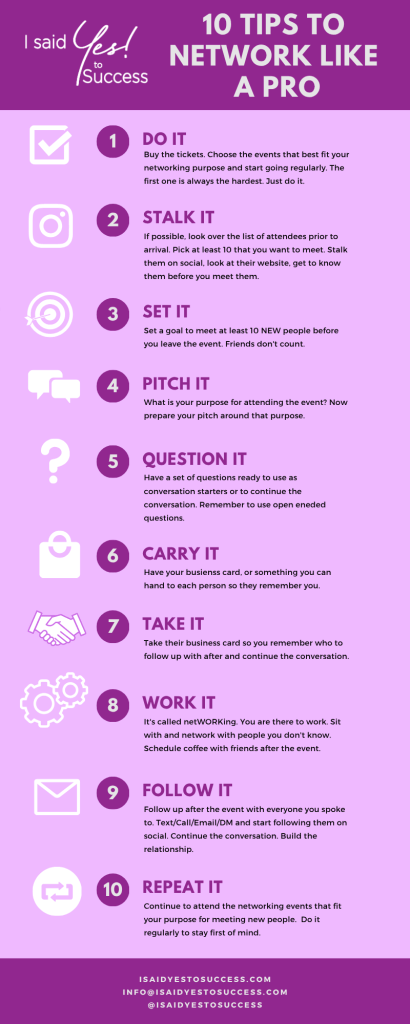
Download our complimentary “10 Tips to Network Like a Pro” infographic and start building connections that move your business forward.
Sign up to receive our weekly newsletter filled with helpful articles, local wedding pro events and exclusive I Said Yes! opportunities.